Every little detail counts in the post-production of a movie. A project can take months or even years to perfect, from the final color grade to the final audio mix. However, the final theatre screening prior to delivery is still an essential step even after editing, grading, sound design, and mastering are finished.
At Color Planet Studios, we consider the final phase of the film quality control process to be equally crucial as the initial cut. A professional theatre screening guarantees that your movie transfers flawlessly from the studio to the big screen, precisely as viewers will perceive it.
What is the Film QC Process?
The Film QC Process, also known as the Quality Control Process, involves reviewing a completed film prior to its delivery to distributors, OTT platforms, and theatrical exhibitors. This ensures that the film meets the following conditions:
- The picture is of flawless quality.
- The audio is well-balanced and synced.
- The subtitles and captions are correct.
- There are no issues of glitches, dropped frames, or artefacts.
- The film meets the technical specifications.
Why Quality Control in Post Production is Essential
Quality control in post-production is crucial for maintaining both the artistic vision and the producer's financial investment. A small mistake that might be missed on a studio monitor can turn into a big problem when viewed on a massive cinema screen.
Some common issues found during the final QC include:
- Minor color banding that only shows up in large projections
- Audio peaks that can distort in theatre sound systems
- Shadow details that end up lost in cinema projections
- Subtitles that aren't properly aligned
- Errors in DCP packaging
If these mistakes are found after the film is distributed, it can come with hefty financial and reputational costs.
So, the final screening isn’t just a formality — it’s a protective measure.
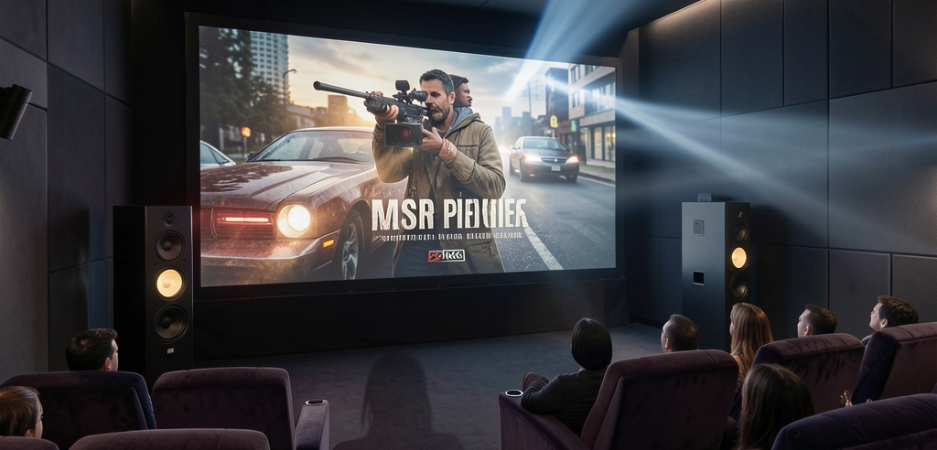
Theatre Screening Before Delivery: The Real Test
A theatre screening before delivery allows the filmmakers to see their film in a real theatre setting:
- Large screen format
- True brightness levels of a theatre
- Professional surround sound equipment
- Audience viewing distance
A film might look great on a grading monitor, but when projected through a projector, it might look different. Even small changes in color and contrast can become apparent.
During a theatre screening, they look at:
The accuracy of color on a large screen
Perceived contrast and brightness can be changed by cinema projection. Blacks, highlights, saturation, and skin tones must all feel consistent and organic.
Sound Quality
At theatrical levels, LFE (low-frequency effects), surround effects, background score balance, and dialogue clarity are evaluated.
Visual Artefacts
Only in large-scale projection can dead pixels, compression artefacts, flicker, frame skips, or edge cropping be seen.
Placement of the Title and Subtitle
Safe spaces are important on a theatre screen. The back row must be able to read the subtitles without being interrupted.
This phase guarantees that the viewers get the exact experience that the filmmakers had in mind.
Cinema Projection QC: Technical Validation That Matters
Technical validation of the DCP and projection performance is part of Cinema projection QC, which is more than just watching the film. Among other things, during this time, we check for:
- The correct aspect ratio (scope or flat)
- Proper masking and framing
- Accurate brightness (measured in foot-lamberts)
- Audio channel mapping (5.1 / 7.1 / Atmos compatibility)
- The DCP is encrypted, and the keys are valid
- Sync stability from start to finish.
A small problem like incorrect channel mapping could ruin the audience experience.
Cinema projection QC makes sure the film is ready for exhibition, technically compliant with all standards, and able to be distributed safely.
The Reasons Studio Monitors Are Insufficient
Calibrated speakers and monitors are necessary for mixing and grading in post-production studios. Cinema projection systems, however, exhibit distinct behaviours.
For instance:
- Screen size and projection brightness interact
- Theatre ambience has an impact on how contrast is perceived.
- Dialogue clarity is altered by sound reflections.
- Bigger screens make small flaws stand out.
- Real-world exhibition conditions can only be replicated in a theatre setting.
The Creative Advantage of Final Screening
- Gaps in pace
- Emotional shifts on a large screen
- Absence of background information
- Sound transitions that require improvement
At Color Planet Studios, we understand final QC to be the last and most critical checkpoint – because once your project leaves our studio, there are no second chances. Contact us now.